As related in the book, NIGHTSTALKERS, published by Casemate Publishing (UK) in November 2022, the combat crew of Captain Earle Smith served a ten-month tour with the 868th Bombardment Squadron of the 13th Bomber Command, Thirteenth U.S. Army Air Force (USAAF), in the South Pacific during the period September 1944- July 1945. At the time that Captain Smith’s crew joined the 868th “Snoopers” in the South Pacific, the Thirteenth USAAF was one Army Air Force component of the Far East Air Forces (FEAF), the latter having grouped together the 13th USAAF and the 5th USAAF in June 1944
The formation of the Smith crew, its dispatch to the South Pacific and selected events in that crew’s service with the 868th is covered in Chapters 15 and 16 of NIGHTSTALKERS. Several original documents provide additional detail on the movement into the Pacific Theater of the Smith crew and its activity in the conflict, as do selected photos related to the Smith crew.
These documents and photos include the following:
1 SPECIAL ORDERS NUMBER 23, 23 January 1944
2 OPERATIONS ORDER NUMBER 5(SECRET), 5 August 1944
3 Letter Orders, 3 September 1944
1
SPECIAL ORDERS NUMBER 23 (RESTRICTED), 23 January 1944, 18th Replacement Wing, directs the onward movement of sixteen B-24 combat crews (SL 2502-2517), to their next assignment. Crew 2505 on those Orders is that of Smith, with this document showing eight men of the Smith crew who would later enter combat in the South Pacific. Note that these orders assume that some men (the “Filler Crew”) may travel by train to their new station and that, in such a case, the per diem meal allowance was “not to exceed $1.00 per meal when taken in the dining car.”


2
OPERATIONS ORDER NUMBER 5 (SECRET), 5 August 1944, directs the movement of three B-24J aircrews and aircraft, those of Captains Robert Wallace and Earle Smith and that of Lt. James Fredrickson, to deploy from their US staging airbase to Australia, and from there, to onward deploy to Port Moresby, New Guinea, and at location reporting to the Commanding Officer, FEAF Combat Replacement and Training Center. These orders represented a “Permanent Change of Station” (PCS) for these three crews. Note that the third crew identified in this document, that of Lt. Fredrickson, would become, in service with the 868th, the crew of the co-pilot Lt. William Beaver at the point he was rated as a Command Pilot. The ten men of the Beaver crew would be lost in March 1945 near Manado, Dutch East Indies, when rammed head-on by a Japanese fighter, as related in Chapter 17 of Nightstalkers.


3
Letter Orders, 3 September 1944, Headquarters, 13th Air Force, APO 719, temporary duty orders authorizing four 868th air crews, those of Captains Earle Smith and Robert Wallace and Lieutenants Erric Muller and Charles Binford, ten days of temporary duty at APO 922 (in Australia).

4
868th Standard Mission Report, 868-333 of 5 October 1944, one SB-24J aircraft number 902, (SECRET), recording this combat mission for the Smith crew. This is the mission report detailing the Smith crew’s unsuccessful daylight attack on an “Agano class light cruiser” at anchor, as referenced in Chapters 16 and 17 of Nightstalkers.

5
868th Standard Mission Report, 868-345 of 13 October 1944, one B-24J1 aircraft number 271, (SECRET), relating a Smith crew mission to the Makassar Straight recording a bomb and gunfire attack on a Sugar Charlie cargo vessel.

6
868th Squadron Administrative Orders “Removal of Suspension Flying Duties” of 7 January 1945, directs that three 868th aircrews, those of Smith, Barry and Beaver be reinstated for combat flying, reversing the “grounding of combat crew personnel instruction” of 13 December 1944. The grounding, in the case of the Smith crew, occurred directly after the mission in which the crew was badly shot-up, with co-pilot Lt. Gene Morgan dying of wounds received and other crew members wounded.

7
GENERAL ORDERS NUMBER 227, 7 February 1945, Headquarters FEAF, posthumously awards the Distinguished Flying Cross to the co-pilot of the Smith crew, Lt. Eugene Morgan. He had been badly wounded over Miri, Borneo on 10 December 1944, a mission referenced in Chapter 17 of Nighstalkers, had come back to base alive, but died a few days later.

8
SPECIAL ORDERS NUMBER 188 of 7 July 1945 (RESTRICTED), Headquarters Far Eastern Air Forces, “Return of Combat Crew” instructions for transfer to USA of 17 officers of the 13th USAF and 5th USAF as their tours of combat duty have been completed. In addition to Captain Smith, several other veterans of the 868th are covered by these same orders.


9
Photo One- The crew of Captain Earle, taken on Noemfoor Island in the October 1944 period, ten original crew members as listed on above Operation Order Number 5 of 5 August 1944. Aircraft (396) was the first B-24J to join the 868th Squadron, arriving in February 1944. In this photo 396 had recently been “given up for adoption” by its original crew, that of Art Deland, when the latter closed out its combat tour and departed for reassignment in the USA. The DeLand crew had “owned” its “396” since early 1944 when DeLand flew to the South Pacific from Langley Field, Virginia. The DeLand crew named their aircraft “Ready, Willing and Able” and had the image of the lady and name painted on the nose of 396 a few days before departure from Langley. When the DeLand crew agreed to hand-over “396” to the Smith crew, the Smith crew was permitted to change the name of the aircraft. The deal was cut and the image of the lady remained untouched. Smith and crew would own “Our Baby” until its crash landing on a return from mission in January 1945. These events are related in Chapters 16 and 17 in the book Nightstalkers.

10
The four officers of the Smith crew at Langley Field shortly before their departure for the South Pacific in September 1944. This aircraft (44-40897) is identified on the above Operations Order Number 5 of 5 August 1944. The four men pictured are (left to right), (pilot) Captain Earle Smith, (co-pilot) Lieutenant Eugene Morgan, (navigator) Leonard Tuft, and (bombardier) Flight Officer Ronald Moyer (kneeling).

11
Two 868th Squadron flight maintenance men pose with “Our Baby”, Elmer Pollock and Larry Berry (identities to be confirmed) with the latter fondly remembered as the “ finest artist in the Command, as long as he was painting the Vargas nudes”.

12
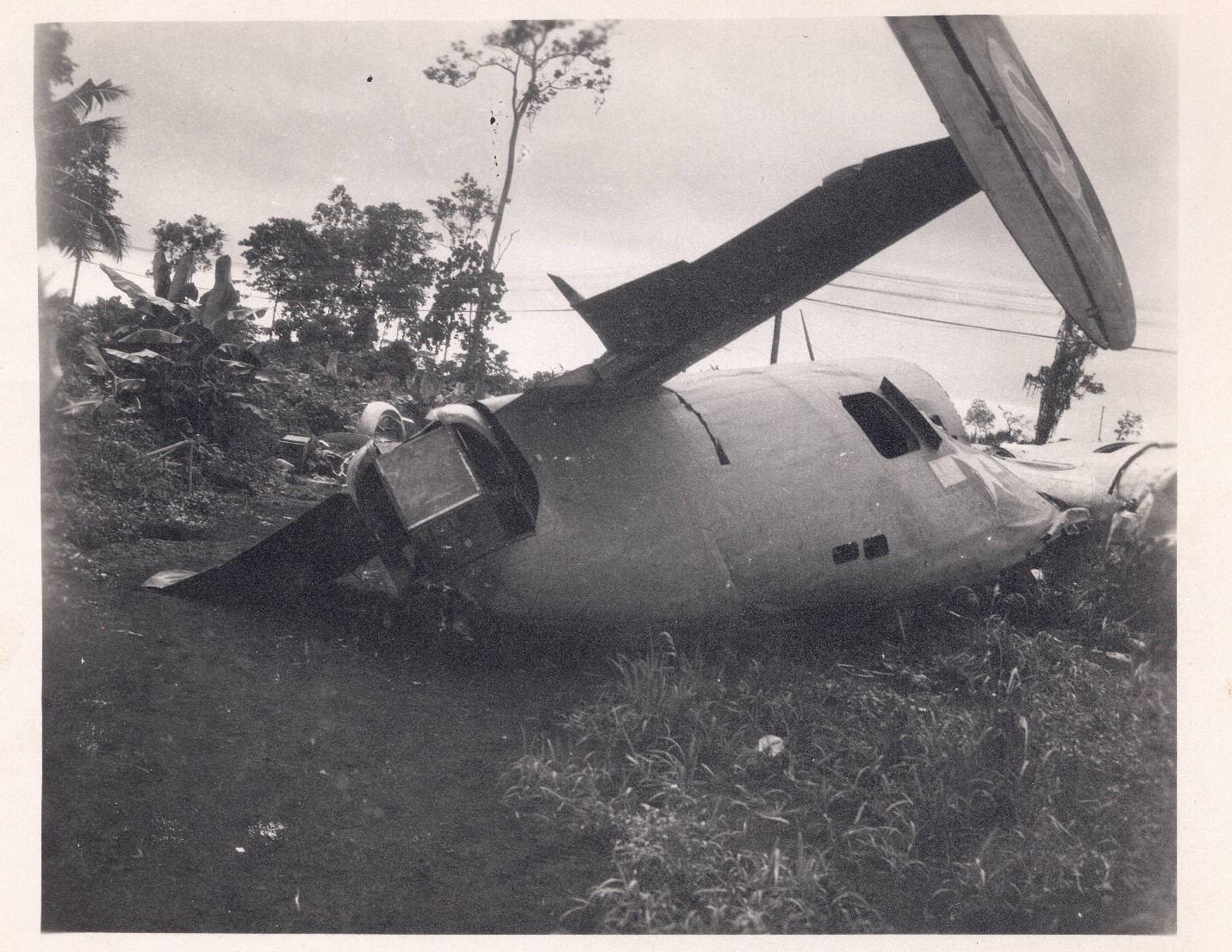
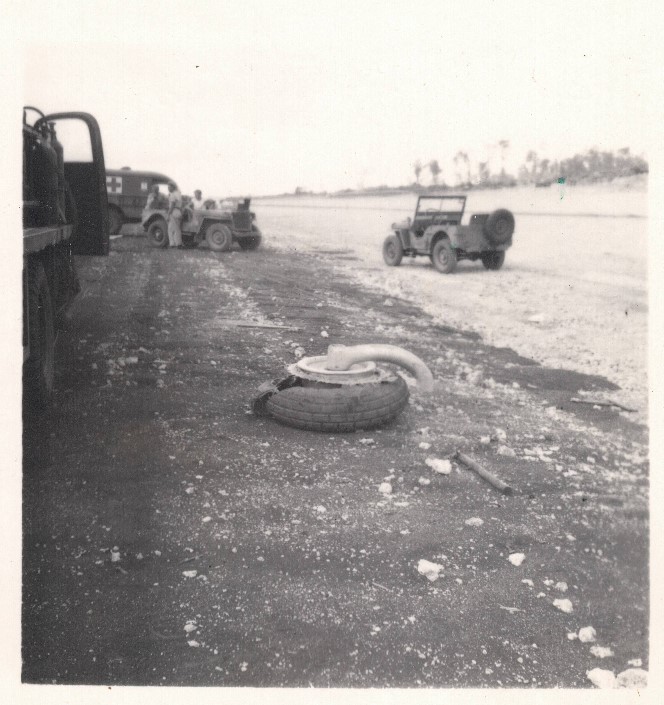
Twelve photos of the crashed “Our Baby”, several taken as rescue crews surround the broken aircraft. Nine crewmen have crawled free or been pulled from the wreckage. The truck-mounted crane is attempting to clear a path to recover the aircraft engineer, Staff Sargent Sidney Pallet, who remained trapped in the collapsed bomb bay until extricated an hour or so after the crash. Four of these photos show “Our Baby” in pieces in the local “boneyard”, with the shattered nose turret from which the gunner, Sargent Paul “Rags” Ramaglia , was pulled after his position after that turret sustained a direct hit from a 25MM explosive round. Other boneyard photos show the rear of the “396” aircraft, the remains of the left nose art as painted (possibly another resident of the boneyard). Note mission marks in this photo- some 85 or so. Both the Deland and Smith crews loved their “396”, and, as one veteran commented, “She always took us to the target and she brought us home, one way or the other, even when she was shot to hell.”




13
Reconstruction by Captain Smith of the January 1945 mission which resulted in the crash landing of badly-damaged “396”. Smith copied his mission report to his personal journal and shared it with the author.
