The B-24D aircraft “Devil’s Delight” would be closely associated with the Wright Project from that unit’s inception at Langley Field, Virginia in June 1943, through its dispatch as the lead aircraft embarking “Crew One” to the South Pacific in early August. In that deployment into combat she was piloted by project leader Colonel Stewart “Stud” Wright. In the project’s first combat mission, a three-plane all-night search up “the Slot”, she embarked Colonel Wright and Colonel Unruh, Commander of the 5th Bomber Group. Over the next many months this Consolidated Aircraft-built, U.S. Army Air Force serial number 42-40832 heavy bomber would fly into-the-night search missions from Guadalcanal, Munda, Momote airfield in the Admiralty Islands and from airfields beyond, hunting her prey, delivering low-altitude bombing (LAB) bombing attacks with precision. “Devil’s Delight” and Crew One was originally commanded by Major Leo Foster, who would succeed Colonel Wright as the project’s commanding officer when Colonel Wright went home to report to General Hap Arnold on the success of the technology and LAB tactical concept.
When Major Foster assumed project command in early October 1943, his place as the crew’s command or first pilot was taken by Lieutenant Vince Splane, a veteran B-17 and B-24 pilot then serving on Guadalcanal with the 5th Bomb Group of the Thirteenth Bomber Command. Lt. Splane would continue to serve as the command pilot with this crew and as such, as missions were posted, have first claim on “Devil’s Delight”. Splane, in company with most of Crew One, rotated back to the USA in early summer 1944. “Devil’s Delight” was considered a dependable aircraft in that was always “mission ready”, with all systems declared “go”, and its LAB radar and computer systems finely tuned by the project’s “radar shack” wizards. Although records are unclear as to when she was lost, it appears her luck ran out when she carried a fated crew on a night attack on Truk in early summer 1944.
These documents and photos include the following:
1 The Wright Project members assemble at Langley Field
2 The same photo as 1, with extensive penned-in names
3 The original crew of “Devil’s Delight”
1
The Wright Project members assemble at Langley Field, Virginia in early-August 1943 a few days before the departure of the ten Consolidated B-24D aircraft and one hundred officers and men assigned to travel to the South Pacific to join the Thirteenth Air Force. Here they are gathered in front of the lead aircraft of Project, “Devil’s Delight”, aircraft serial number 42-40832. In the deployment to the South Pacific theater the mission leader, Colonel Stuart Wright, would fly this aircraft as the mission lead airplane and crew. (The author restored this photo from a damaged version of the original, see image 2 below.)

2
The same photo as Image 1, with extensive penned-in names identifying many of the original Wright Project officers and men. The photo was placed on a table at each of the 868th Squadron reunions during the 1970’s and 1980’s to allow the veterans to write in the names of the individuals in the photo.

3
The original crew of “Devil’s Delight” a few weeks after the Wright Project’s arrival at Carney Field on Guadalcanal in late August 1943. This crew, initially commanded by Major Leo Foster, would fly combat missions for ten months, typically claiming “Devil’s Delight” as their own. These men rotated back to the USA in the summer of 1944 by which time all had completed 50 or more combat missions. In October 1943, when Major Foster assumed command of the Wright Project upon the departure of Colonel Wright, Major Foster’s position as aircraft commander or command pilot was assumed by Lieutenant Vince Splane, an experienced B-17 and B-24 combat pilot. Splane would remain the command pilot for the crew and continue to “own” the aircraft- meaning that he and his crew would enjoy a “first call” on this airplane for any assigned mission, assuming that it was then declared “mission ready”, which this particular plane invariable was. In this image note that the crew had observed security protocols by covering the antenna for the IFF systems with a flight jacket.

4
A photo of the left side of the aircraft, probably taken at Carney Field in September 1943, with the IFF antenna un-protected, a security violation for sure.

5
A photo of the left nose area with Wright Project member not identified, probably taken at Guadalcanal in late 1943 shortly before the squadron’s relocation forward to Munda and its re-designation as the 868th Bomb Squadron. The aircraft shows 25 “mission marks” or bombs just forward of the cockpit windows, and the IFF antenna is here concealed with a crewman’s shirt. Note that the original paint scheme, which featured bright red hair of the Devil’s Delight lady, had by now been toned down to a “dull orange”, as recounted by a former member of this crew. This was done at the insistence of senior officers of the Thirteenth Bomber Command who were concerned that the original color would draw the fire of over-eager anti-aircraft gunners at the airfield who had established a reputation of shooting at any aircraft sporting red!

6
Three SB-24D aircraft of the newly-designated 868th Bomb Squadron at rest on Munda Field in early 1944. Back to front these are: “Madame Libby the Sea Ducer” (838), “Devil’s Delight”(832), and “Ramp Tramp” (651).

7
“Devil’s Delight” returning from its 50th mission, with the flight engineer Technical Sargent Sam Pona sitting atop the aircraft as it taxies to its hardstand, mission accomplished.

8
A very tired “Devil’s Delight” with 62 Missions to her credit, probably captured at either Munda or when based at Manus in the Admiralty Islands.

9
“Devil’s Delight” under repair after damage to her nose area, resulting from a partially-collapsed front landing gear. Note circled strike mark- a Japanese hinomaru”, which will be cut away when damaged nose area is rebuilt by the squadron’s “metal shop”, also identified as the “metal benders”.

10
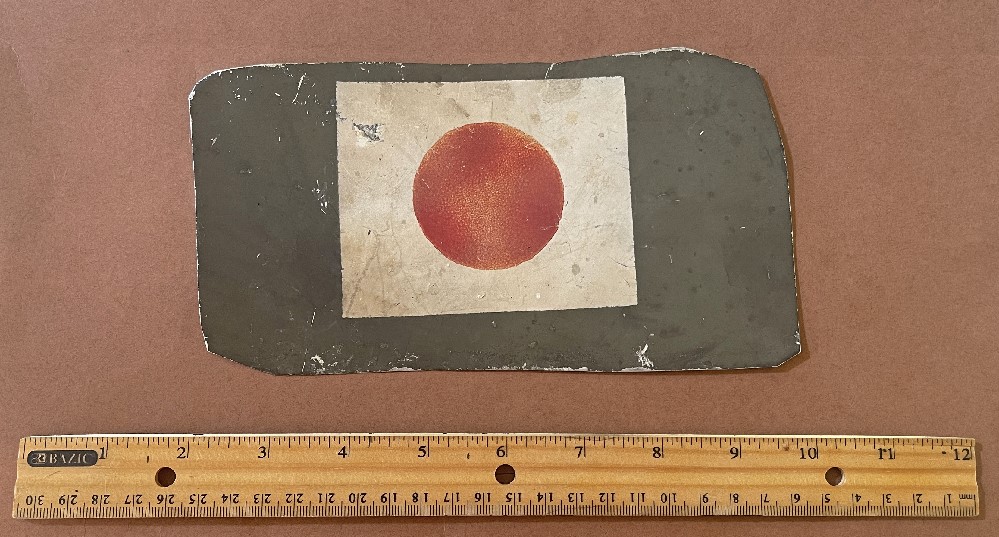
The cut-out strike mark, the only known remnant of “Devil’s Delight” , presented to the author in 1982 by a member of the original crew. (As circled in red in previous image.)
11
The reverse side of the cut out Japanese flag strike mark, showing the aluminum skin of Devil’s Delight” , with the “ALCLAD” identifier of the original metal skin of the aircraft.

12
“Operations Order 111″, dated 19 October 1943, designates Vince Splane and Charles Conrad as “Principal Pilots” for B-24 type aircraft, by order of Colonel Unruh, Commanding Officer of the Fifth Bomb Group of the Thirteenth Air Force. At this point Unruh has reassigned three of his B-24 lead pilots to serve with the Wright Project, in the case of Splane as a replacement for Major Leo Foster, the former command pilot of the “Devil’s Delight” crew.

13
“Consolidated Mission Report” of the 5th Bomb Group, dated 4 November 1943, classified SECRET, reporting on Mission Number 189 of previous day, detailing a mixed group of B-24 aircraft from that Group, accompanied by one “ SB-24 type aircraft from the Fifth Bomb Group Project this Group” . The 22 aircraft mission was led by group commander Colonel Unruh and encountered fighter resistance, resulting in the loss of one aircraft damaged, forcing a water landing, and second aircraft heavily shot up but successfully landed. This mission, launched from Munda as an advanced base or staging airfield, may have been the first instance where a Wright Project SB-24 acted, or attempted to serve, in a “pathfinder” role to assist the daylight formation to locate its target in a condition of inclement weather. This Mission Report highlights the difficulty faced by daylight bomber formations penetrating heavy weather and finding and attacking their assigned target- in this case a reported convoy of Japanese Navy cargo ships approaching New Ireland. This critical contribution by the newly-arrived SB-24 and its radar capabilities is addressed in the “Remarks” section of the mission report. (Two Pages)


14
“Consolidate Mission Report” of the 5th Bomb Group, dated 26 August 1943, classified SECRET, reporting on Mission Number 72 of the previous day, that sent 11 daylight B-24’s to attack the Japanese at Kahili Airdrome. This mission was again led by Colonel Unruh as the group commander, who occupied the left side command pilot seat while Lt. Splane flew as his co-pilot. Notably, this daylight mission was being flown only two days after the Wright Project arrived on Guadalcanal, and the Project would fly its first combat patrols the night of 27-28 August. Colonel Unruh would be along for the mission, aboard “Devil’s Delight” as a special observer to learn how the LAB system worked in combat. (See “Nightstalkers” Chapter 10, Vince Splane and “Devil’s Delight” for a first-person account of then Lt. Splane’s missions with Colonel Unruh prior to his joining the Wright Project.) (Four Pages)


